
How a tendon-driven hand works
Your own hand does it this way
Bend your fingers and feel your forearm: the muscles that curl your fingers are mostly in the forearm, not in the fingers. Long tendons run from those muscles, through the wrist and palm, to the finger bones. When a muscle pulls, the tendon pulls, and the finger curls.
This hand copies the idea:
| Your hand | This robot hand |
|---|---|
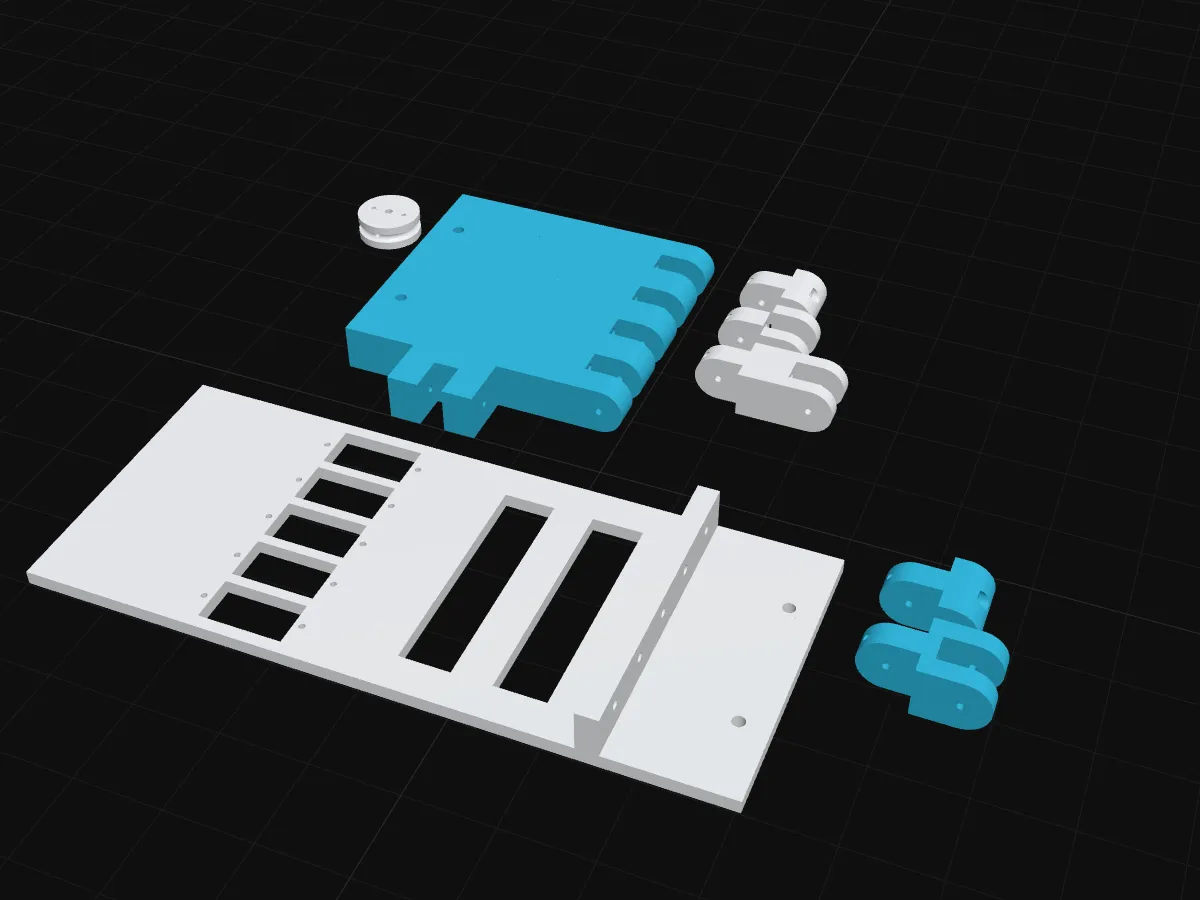
| finger bones | three printed phalanges per finger, joined by hinge pins |
| flexor tendon on the palm side | braided fishing line in a channel on the palm side |
| muscle in the forearm | an MG90S servo in the printed forearm, with a spool that winds the line |
| extensor tendon on the back | elastic cord in a channel on the back, pulling the finger straight |
One servo per finger, five in total. The servo winds the line in: the finger curls. It lets the line out: the elastic straightens the finger.
How far must the string move?
A tendon that runs a small distance away from a hinge acts like a lever. That distance is the moment arm . If the joint bends by an angle (in radians), the tendon has to be pulled by
The tendon runs over all three joints of the finger, so to bend all three, it moves by the sum:
The spool on the servo has a radius . Winding of line onto it needs a rotation of
Why the fingers do not all curl the same way
With one tendon over three joints, the finger curls where it is easiest first. Usually the joint nearest the palm bends first, then the others. A real finger has extra tendons to control each joint separately; ours is simpler, and that is fine for grabbing a ball or showing gestures. The anthropomorphic hand guide goes further.
What the code does
- Flex from 0 (straight) to 1 (curled) for each finger, turned into a servo angle between the finger’s calibrated open and closed angles.
- Grips (presets): open, fist, point, pinch, peace, rock, thumbs up, each a set of five flex values.
- Smooth motion: every finger moves at a limited speed, so a grip closes instead of snapping.
- Stall protection: a servo holding a grip against an object pulls hard and heats up. After 1.5 s, the code backs each gripping servo off a few degrees: the object usually stays held, and the servo cools.
You control it from your phone: the hand makes its own Wi-Fi network with a button for every grip and a slider for every finger.
What is in this guide
- How a tendon-driven hand works (this chapter, free)
- Parts and printing
- Assembly: fingers, tendons, elastic, spools, wiring
- The code and calibration
- Troubleshooting and what next


