Prima edizione

Bionic Hand (simple, tendon-driven)

Five fingers pulled by tendons, one servo each. Grip, point and wave from your phone. An educational robotics project.

Difficoltà
Beginner to intermediate
Tempo di costruzione
2 to 3 evenings
Guida digitale 18 €
Ordina via email

Rispondiamo entro un giorno con i dati di pagamento (bonifico o PayPal) e ti mandiamo i file via email subito dopo il pagamento.

Ricevi PDF, codice e file 3D via email. Prezzo comprensivo di tutte le tasse.

Kit con componenti 85,50 €

Il kit include la guida. Avvisami quando il kit è pronto.

Questa pagina non è ancora tradotta, quindi è mostrata in inglese.

Cosa ricevi

  • PDF guide: how tendons move a finger, printing, assembly, calibration, grip presets
  • MicroPython firmware with a phone control page and stall protection, plus unit tests for the maths that you can run on a computer
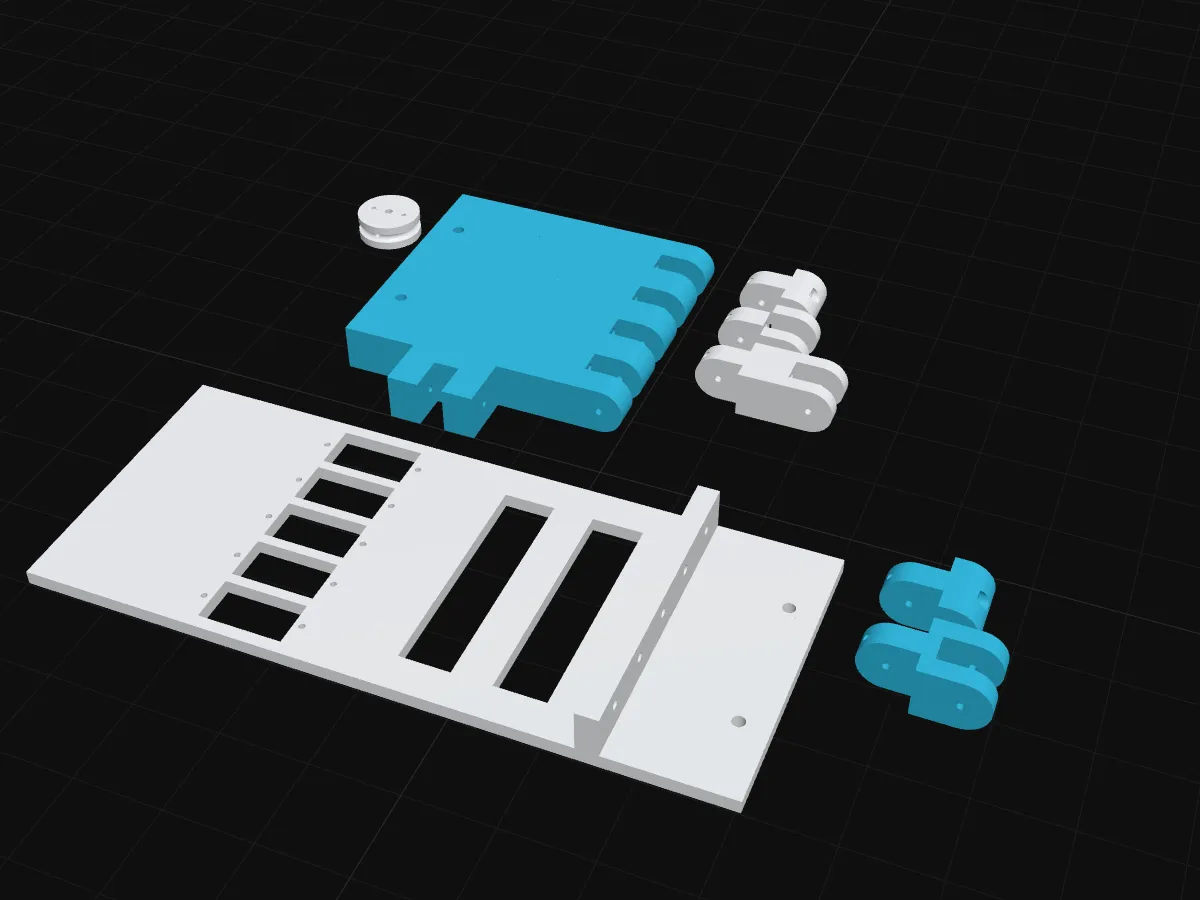
  • Printable fingers, palm, forearm and spools (OpenSCAD source + STL)

Per chi è

Beginners interested in bio-inspired mechanisms. No soldering. This is a robotics model, not a prosthesis or a medical device.

Each finger is three printed parts joined by pins cut from 3D-printer filament. A fishing-line tendon curls the finger and an elastic cord straightens it. Simple, cheap, and it moves surprisingly like a real hand.

Componenti necessari

  • 1× ESP32 DevKit, 38-pin, ESP-WROOM-32, CP2102, USB-C
  • 5× MG90S metal-gear micro servo, 180°
  • 1× Power adapter 5 V 4 A, 5.5×2.1 mm barrel plug
  • 1× DC barrel jack 5.5×2.1 mm female to screw terminal adapter
  • 1× Electrolytic capacitor 1000 µF (16 V or higher)
  • 2× Solderless breadboard, 400 points (half size)
  • 20× Dupont jumper wires male–male 20 cm (pack of 40)
  • 3× Braided fishing line ~0.3–0.4 mm, ≥15 kg (per metre)
  • 2× Round elastic cord 1 mm (per metre)
  • 8× M3 screw, 8–20 mm, with nut (from an assortment box)
  • 10× M2 × 5 mm self-tapping screw
  • 1× USB-C data cable 1 m (USB-A to C)
  • 4× Finger set (3 phalanges) 3D
  • 1× Thumb set (2 phalanges) 3D
  • 1× Palm 3D
  • 1× Forearm (servo bed) 3D
  • 5× Tendon spool 3D

Non incluso nel kit

  • Nothing else needed besides a computer

La lista completa con negozi e alternative più economiche è nella guida.

Dai un'occhiata

Il primo capitolo della guida, gratis da leggere.

How a tendon-driven hand works

Your own hand does it this way

Bend your fingers and feel your forearm: the muscles that curl your fingers are mostly in the forearm, not in the fingers. Long tendons run from those muscles, through the wrist and palm, to the finger bones. When a muscle pulls, the tendon pulls, and the finger curls.

This hand copies the idea:

Your handThis robot hand
finger bonesthree printed phalanges per finger, joined by hinge pins
flexor tendon on the palm sidebraided fishing line in a channel on the palm side
muscle in the forearman MG90S servo in the printed forearm, with a spool that winds the line
extensor tendon on the backelastic cord in a channel on the back, pulling the finger straight

One servo per finger, five in total. The servo winds the line in: the finger curls. It lets the line out: the elastic straightens the finger.

How far must the string move?

A tendon that runs a small distance away from a hinge acts like a lever. That distance is the moment arm mm. If the joint bends by an angle φ\varphi (in radians), the tendon has to be pulled by

Δl=m⋅φ\Delta l = m \cdot \varphi

The tendon runs over all three joints of the finger, so to bend all three, it moves by the sum:

Δl=m⋅(φ1+φ2+φ3)\Delta l = m \cdot (\varphi_1 + \varphi_2 + \varphi_3)

The spool on the servo has a radius rsr_s. Winding Δl\Delta l of line onto it needs a rotation of

α=Δlrs\alpha = \frac{\Delta l}{r_s}

Why the fingers do not all curl the same way

With one tendon over three joints, the finger curls where it is easiest first. Usually the joint nearest the palm bends first, then the others. A real finger has extra tendons to control each joint separately; ours is simpler, and that is fine for grabbing a ball or showing gestures. The anthropomorphic hand guide goes further.

What the code does

  • Flex from 0 (straight) to 1 (curled) for each finger, turned into a servo angle between the finger’s calibrated open and closed angles.
  • Grips (presets): open, fist, point, pinch, peace, rock, thumbs up, each a set of five flex values.
  • Smooth motion: every finger moves at a limited speed, so a grip closes instead of snapping.
  • Stall protection: a servo holding a grip against an object pulls hard and heats up. After 1.5 s, the code backs each gripping servo off a few degrees: the object usually stays held, and the servo cools.

You control it from your phone: the hand makes its own Wi-Fi network with a button for every grip and a slider for every finger.

What is in this guide

  1. How a tendon-driven hand works (this chapter, free)
  2. Parts and printing
  3. Assembly: fingers, tendons, elastic, spools, wiring
  4. The code and calibration
  5. Troubleshooting and what next

Domande

Can this be used as a prosthetic hand?

No. It is an educational robotics project. It is not designed, tested or certified for use on a person.

Is this tested?

No. This is a first edition: the parts are designed and checked in CAD, not yet printed and assembled. Kits are not on sale yet.

Guida digitale 18 €
Ordina via email

Rispondiamo entro un giorno con i dati di pagamento (bonifico o PayPal) e ti mandiamo i file via email subito dopo il pagamento.

Ricevi PDF, codice e file 3D via email. Prezzo comprensivo di tutte le tasse.

Si abbina a